
I’ve always wanted to attend the Bridge Conference but never had the chance. The FOMO was especially strong this year because marketing professor Americus Reed II delivered the keynote. While I had to settle for reading the Chronicle of Philanthropy’s coverage afterward, I was grateful to see someone bring a thoughtful conversation about brand to a nonprofit audience.
Brand can be an uncomfortable word in our sector. It sometimes feels too commercial or disconnected from mission-driven work. Many nonprofit leaders hear the word brand and immediately think of logos, colors, or marketing campaigns.
Reed reminded the audience that every nonprofit already has a brand, whether it intentionally shapes it or not.
He said, “Your brand is what people associate with your organization — good or bad.”
Your brand is the story people tell themselves about who you are, what you stand for, and why your work matters.
That insight is critical.
Too often, nonprofits view branding as a marketing activity when it is really an organizational one.
Three Identities Shape a Nonprofit Brand
A clearly defined brand gives an organization something to measure decisions against. Every day, nonprofit leaders decide which opportunities align with their mission, which partnerships advance their goals, and how to invest limited resources. When everyone shares the same understanding of the organization’s identity, those decisions become more intentional and more consistent.
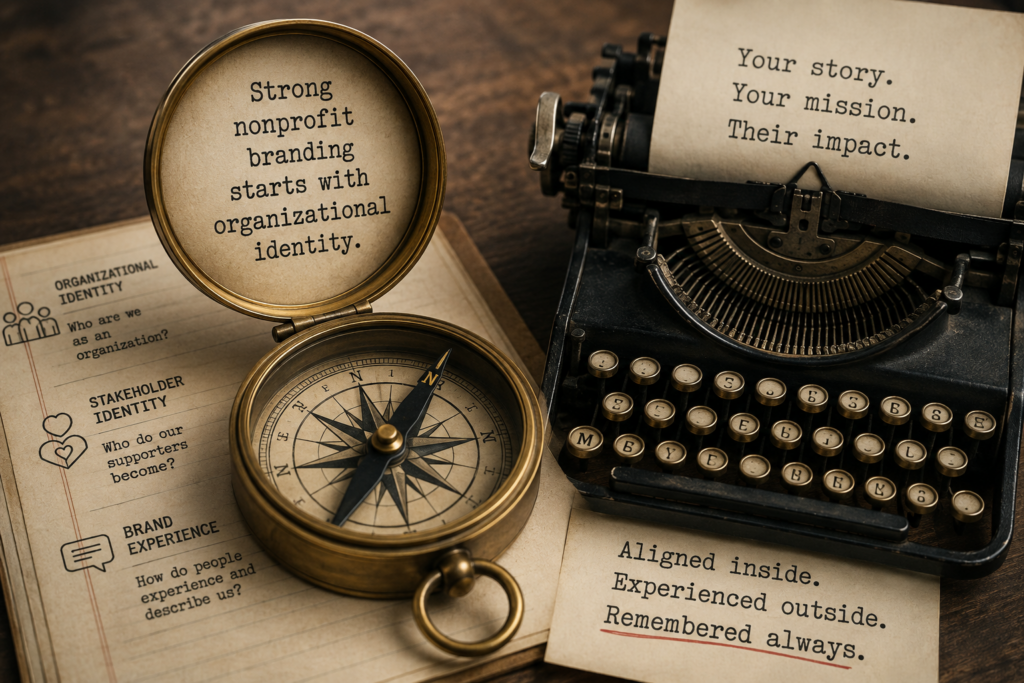
I’ve come to think about nonprofit brands through the lens of three interconnected identities. Together, they shape how an organization is understood, experienced, and remembered.
That happens when three identities work together.
- Organizational identity: Who are we as an organization?
- Stakeholder identity: Who do our donors, volunteers, employees, and partners become by being part of our mission?
- Brand identity: How do people consistently experience and describe our organization?
Americus Reed’s keynote focused on stakeholder identity—how nonprofits help people see themselves in the causes they support. I’d like to build on that idea by exploring how organizational identity shapes the experiences that ultimately define a nonprofit’s brand.
People Support Organizations That Reflect Their Identity
One of Reed’s central messages was that people don’t support organizations. They support an identity that reflects who they are or who they aspire to become.
He encouraged nonprofit leaders to continually ask two questions:
Who are we as a nonprofit?
Who are they as a donor?
He argued that the strongest nonprofits help supporters answer an even deeper question:
Who will I become by supporting this organization?
Consider someone making a gift to a food bank. Their donation often means more to them than simply providing meals. It’s an opportunity to express who they are—a neighbor who believes no one should go hungry, someone who steps up when others are struggling, or a person who wants to make their community stronger. In that moment, they’re not just supporting a nonprofit. They’re reinforcing an identity that reflects their values.
That’s a powerful way to think about donor engagement because people give for emotional reasons as much as rational ones. They want their generosity to reflect their values and reinforce the kind of person they believe themselves to be.
I couldn’t agree more. I also think that donors aren’t the only people asking, “Who am I by being part of this organization?” Volunteers, employees, board members, community partners, and even clients are asking the same question. A strong nonprofit brand creates a sense of identity and belonging for every stakeholder, not just those making financial gifts.
Before organizations ask Reed’s questions, I believe they need to answer one of their own.
Does Everyone Inside the Organization Answer “Who Are We?” the Same Way?
Before donors can connect your mission to their identity, your organization has to understand its own identity.
That sounds obvious, but in my experience it’s one of the biggest challenges nonprofits face.
As organizations change and grow, shared knowledge becomes scattered. New staff members bring fresh perspectives. Leadership changes. Programs evolve. Priorities shift. Different departments naturally begin focusing on different aspects of the mission.
Over time, people inside the same organization can begin answering the question “Who are we?” in surprisingly different ways.
The result is more than inconsistent communication. It leads to different decisions, shifting priorities, conflicting stories, and inconsistent experiences for donors, volunteers, partners, and employees.
Strong Brands Start with Shared Organizational Understanding
Shared Organizational Understanding creates alignment around an organization’s identity before that identity is communicated to the outside world.
That means developing a shared understanding of:
- Why the organization exists.
- What problem it is solving.
- How it creates change.
- What makes its approach different.
- What values guide decisions.
- What promises it makes to the people it serves.
Shared Organizational Understanding gives everyone the same foundation for making decisions, communicating consistently, and delivering on the organization’s promises.
Donors hear the same story whether they speak with the executive director, a program manager, a board member, or a volunteer.
Programs reinforce the same mission.
Fundraising supports the same strategic priorities.
Leadership decisions reflect the same organizational values.
That consistency demonstrates authenticity and gives donors confidence that every interaction reflects the same organization. Best of all, it fosters trust, which is one of the strongest foundations any nonprofit brand can have.
Brand Is an Organizational Asset
One of the reasons I loved Reed’s keynote is because it helps move leaders’ understanding of branding beyond logos and visual identity.
A nonprofit’s brand isn’t something created by the communications department.
It’s shaped by every decision the organization makes and every interaction a person has with it.
Stakeholders experience your organization’s identity through every interaction. They don’t experience it all at once. They experience it one interaction at a time.
- A volunteer orientation.
- A grant proposal.
- A fundraising appeal.
- A board meeting.
- A social media post.
- A phone call with a staff member.
- An email thanking a donor.
- A community event.
Each interaction either reinforces your organizational identity or creates confusion about who you are.
Every employee, volunteer, and board member either strengthens that identity or weakens it. A donor may never meet every member of your organization, but over time they’ll experience the decisions those people make.
Reed challenged nonprofit leaders to ask, “Who are we?” and “Who are they as donors?” I’d encourage organizations to answer the first question internally before trying to answer the second externally.
Organizations build strong brands when every person consistently communicates and demonstrates the same organizational identity. When people inside the organization share the same understanding of who they are and why their work matters, stakeholders experience that authenticity in every interaction.
That’s when a brand becomes more than a logo or a fundraising campaign. It becomes a strategic asset that guides decisions, earns trust, inspires loyalty, and invites people to see your mission as part of their own story.
That’s the kind of brand every nonprofit should aspire to build.
If your leadership team is struggling to answer “Who are we?” consistently or if different departments tell different versions of your organization’s story, it may be time to step back and build a stronger foundation.
Let’s talk about how Shared Organizational Understanding can help your organization strengthen its brand, improve decision-making, and create more consistent experiences for donors, volunteers, and the communities you serve.
