
After I posted last week’s blog post on LinkedIn about organizational knowledge, a colleague asked me an important question:
“Curious what you did to get the organizational understanding captured, shared, and used?”
That is the elephant in the room, is it not?
You may assume the answer involves technology. I did at first.
I’ve lost count of how many times I’ve heard leaders—or caught myself—say, “If only we had a better intranet or a knowledge management platform.” Or, “We need a better way to organize our files on the shared drive.”
Those tools and systems certainly have their place. But in my experience, organizations rarely lose knowledge because they don’t have enough places or processes to store information. They lose it because they haven’t created a shared understanding of what that information means.
Information Isn’t the Same as Understanding
Your organization has no shortage of information. Strategic plans, board minutes, budgets, policies, SOPs, reports, presentations, CRM data, internal communications, and years of organizational history all capture pieces of the story. Yet even with all of that information, an organization can still lack the context needed to understand it.
For any given strategy, tactic, decision, or project, do you know:
- Why was that decision made?
- What problem were we trying to solve?
- What did we learn from that initiative?
- Which assumptions still hold true today?
The challenge is that for many organizations, those answers live in the minds of the decision-makers and nowhere else. When those people retire, change roles, or leave the organization, much of that understanding leaves with them.
My Work Starts With Listening
I start every engagement with conversations. I interview leaders, staff members, board members, clients, donors, volunteers, partners, or other stakeholders. I ask people to explain not only what the organization does, but how decisions are made and why the organization operates the way it does. I look for recurring themes, conflicting perspectives, hidden assumptions, and stories that reveal how the organization thinks, makes decisions, and learns over time. It doesn’t take long for patterns to emerge.
In most cases, everyone is working toward the same mission. But in some instances, everyone is describing that mission differently. They have different explanations for the organization’s priorities, programs, or impact. They remember different versions of important decisions, or they assume a version that makes the most sense to them. They use different language to describe the same work.
These different explanations aren’t necessarily wrong. But they make it harder for leaders and staff to make consistent decisions over time.
That’s where the work of building shared understanding begins. Many people think brand strategy begins with logos, messaging, or marketing. In my experience, it starts much earlier—with understanding how an organization thinks, what it has learned, and the ideas that should guide future decisions.
A Real World Example
I work with a long-standing community faith-based organization. Like many organizations with a long history, it had strong traditions, active programs, and dedicated volunteers. But much of the knowledge about why ministries and programs existed, how they connected to one another, and how the organization wanted to present itself lived in the minds of long-time leaders and members.
Working alongside leadership, we began documenting and organizing that thinking. We clarified the organization’s brand foundation, messaging, voice, audiences, communication practices, and strategic priorities. Those ideas became shared digital resources that guide everything from website content and social media to ministry communications, community outreach, volunteer engagement, and leadership communications.
No matter who creates a new program, plans an event, writes a social media post, or communicates with members or the broader community, they have a shared foundation to guide them.
The real value came from making the organization’s thinking and knowledge visible. Instead of relying on institutional memory, leaders, staff, and volunteers had a shared foundation they could use to communicate consistently and move the organization forward together.
Building a Common Language
Rather than simply documenting what people say, I bring those ideas together to create a shared understanding of the organization. Together, we identify the principles, decisions, priorities, and messages that should guide the work moving forward.
This is where strategic communications becomes organizational strategy in action. It becomes the way an organization captures and shares its collective understanding. Instead of leaving important knowledge scattered across conversations and individual memories, we create shared frameworks that staff can use every day.
These frameworks might include:
- Mission and purpose narrative
- Brand frameworks and guidelines
- Messaging frameworks
- Audience personas
- Decision-making principles
- Communication guidelines
- Strategic planning documents
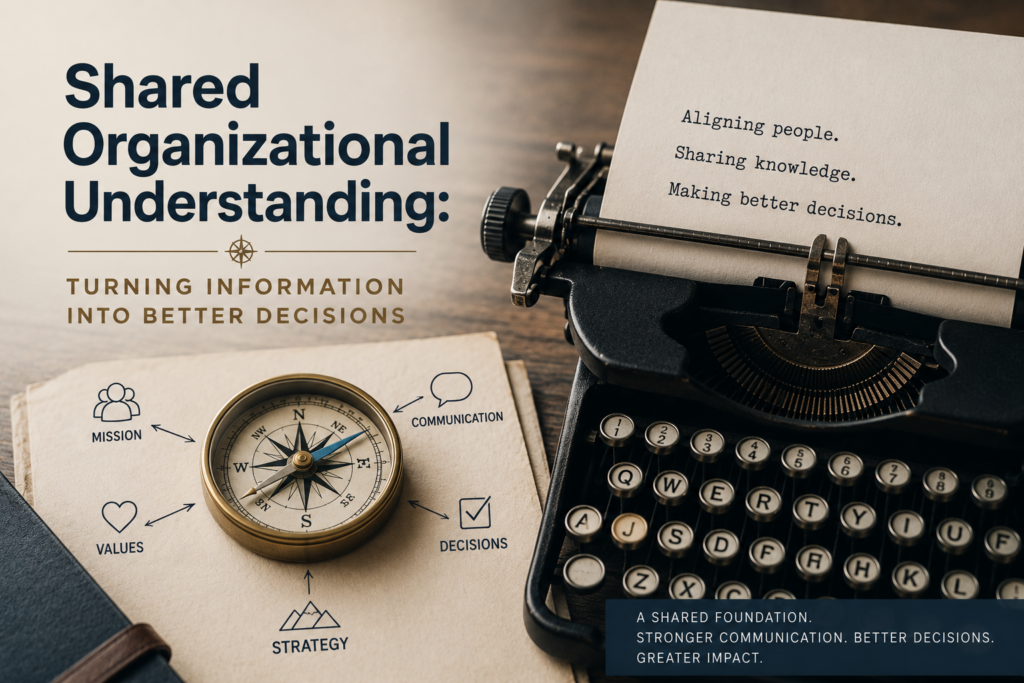
Each framework serves a different purpose, but together they create a common language and shared point of reference. They help people interpret information, communicate consistently, and make decisions with greater confidence.
That shared understanding also extends into many of the organization’s operational resources, including standard operating procedures, onboarding materials, governance documents, partnership agreements, and policy or advocacy agendas.
Shared Understanding Shows Up Everywhere
Once people have a common understanding, it naturally becomes part of the organization.
You begin to see it everywhere:
- Onboarding and training materials
- Leadership presentations
- Strategic plans
- Board discussions and agendas
- Grant proposals and case statements
- Marketing and fundraising materials
- Internal policies and procedures
- External audience communications and channels
Consistency becomes part of the organization’s culture because people are working from the same set of ideas.
Communications Builds Organizational Capacity
I don’t consider myself an operations consultant or a knowledge management specialist. My work focuses on helping organizations develop the shared understanding that allows people to communicate consistently, make better decisions, and preserve what they’ve learned over time.
Technology can store information, and operational systems can reinforce good practices. Strategic communications helps people understand what those ideas mean and how they should shape the organization’s work.
When people understand what matters, why it matters, and how those ideas should shape their work, organizational knowledge becomes something they use every day instead of something that sits in an archive.
Does this sound familiar?
If you’re struggling to preserve institutional knowledge, align communications, or create a shared understanding that supports better decision-making, let’s talk. I’d love to learn more about your organization and explore whether a strategic discovery process could help.
