
Every Answer Had a Different Expert
One of the most important lessons I’ve learned about good leadership had nothing to do with marketing.
When I started a new management role, I focused on learning the organization. Like anyone in a new leadership role, I spent a lot of time asking questions. I wanted to understand the organization’s history, its programs, its growth path, and why certain decisions had been made over the years.
Some questions were easy to answer. Others sent me on a scavenger hunt.
I’d ask why we kept getting calls and emails asking about a particular program that we stopped operating decades ago, and someone would say, “Talk to Sarah. She remembers what happened.”
I’d ask whether we had ever tried a certain marketing strategy before, and someone would point me to a different colleague who remembered if we tried it and what happened.
If I wanted to understand how a long-standing community partnership began, there was someone else who could tell that story.
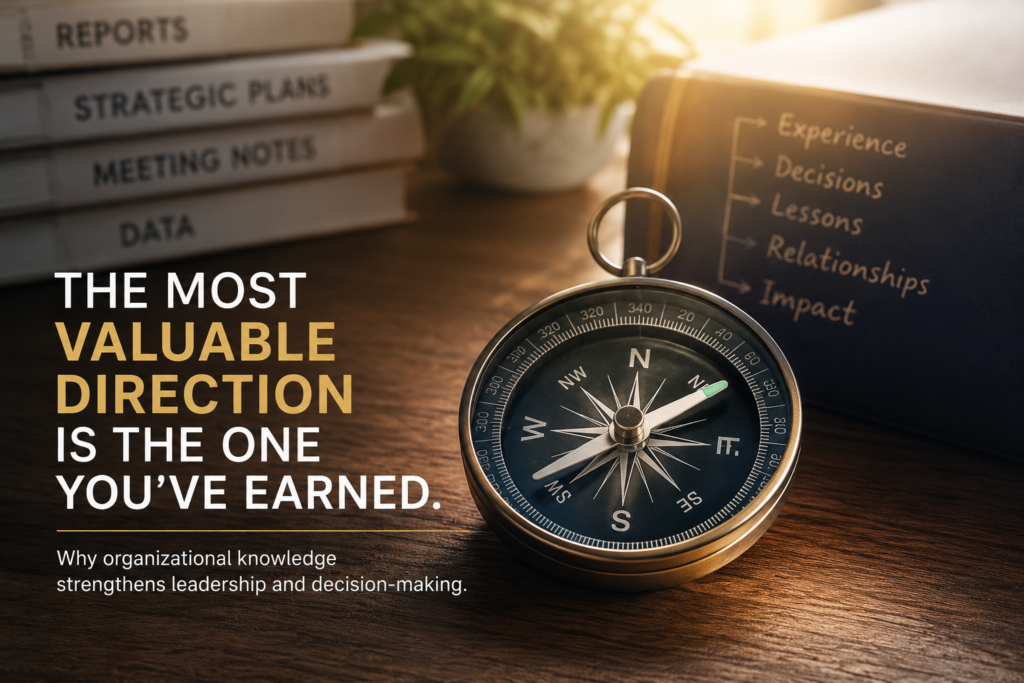
Over time, I realized the organization had an incredible memory. It just wasn’t stored in one place. No one person knew everything, but no system did either. We had strategic plans, reports, and board minutes, but much of the organization’s history, reasoning, and experience had never been intentionally captured. Even the board’s own history lived more in memory than in documentation.
Instead, a handful of long-tenured colleagues held decades of the organization’s history in their heads. They remembered conversations that had never been written down, the reasoning behind major decisions, lessons learned from initiatives that came and went, and relationships that had shaped the organization for years.
At first, I admired it, then I realized how fragile it was.
Growth Changed More Than the Organization
The organization had grown significantly over the years. It had added programs, expanded services, welcomed new leaders, and reached more people than ever before. Like many growing organizations, each program developed the systems that worked best for its own team. There were different databases, reporting methods and ways of tracking clients, outcomes, and success.
None of this happened because anyone made a bad decision. It happened because growth is messy. Each new program solved the problems immediately in front of it. They created systems that worked well individually, but weren’t designed to work together across the organization.
When Simple Questions Aren’t Simple
None of that seemed like a problem until we needed to look across the organization instead of within a single program.
Someone would ask what sounded like a simple question.
“Has this person been served by more than one of our programs?”
It turned out not to be a simple question at all. Someone might have participated in multiple programs over several years, but those experiences often lived in separate systems that didn’t connect. We could see pieces of their story, but not always the whole picture. The same was true for donors, volunteers, even employees.
Comparing outcomes across programs was just as difficult. Each team measured success in ways that made sense for its own work, or for the entities they needed to report to. However, that variability made it hard to understand the organization’s impact as a whole or identify patterns that could make every program stronger.
Seeing the Whole Story
The challenge became impossible to ignore during a major organizational initiative. We wanted to strengthen relationships with the people who cared most about the organization. But we quickly realized we couldn’t always see those relationships clearly.
Did a volunteer eventually become a donor?
Had a former client later joined our staff?
Which programs introduced people to the organization, and which ones kept them engaged over time?
We suspected those stories existed. We just couldn’t easily find them because every system told only part of the story.
At the same time, we discovered another problem. Different audiences had very different perceptions of who we were. Some community members still associated us with programs we hadn’t operated in years. Others knew only one part of the organization and had no idea about the breadth of our work.
As we worked to improve our communications, we realized we first had to understand ourselves. We needed to know what materials existed, what messages people were hearing, what systems needed updating, and what information we could trust. More often than not, the answers lived in conversations rather than documentation.
It sometimes felt less like implementing a strategy and more like rediscovering the organization.
Information Isn’t the Same as Understanding
We didn’t have a shortage of information. We had strategic plans, budgets, reports, policies, meeting notes, and years of data. What we couldn’t always find was the context. Why had a decision been made? What strategies had already been tried? How did one program connect to another? Which lessons had been learned, and which were worth carrying forward?
Every retirement, promotion, or resignation took a little of that organizational memory with it. Sometimes we captured it in time. Sometimes we realized too late that no one had written it down because everyone assumed someone else already knew.
Looking back, I don’t think the organization’s greatest asset was its databases, strategic plans, or reports. It was everything people had learned over decades of serving the community. It was their organizational memory.
Organizational knowledge is one of the few assets that becomes more valuable when it’s shared. If you’re ready to turn years of experience into a resource your entire organization can build on, let’s schedule a conversation. I’d love to learn about your organization and explore where that knowledge lives today.
