
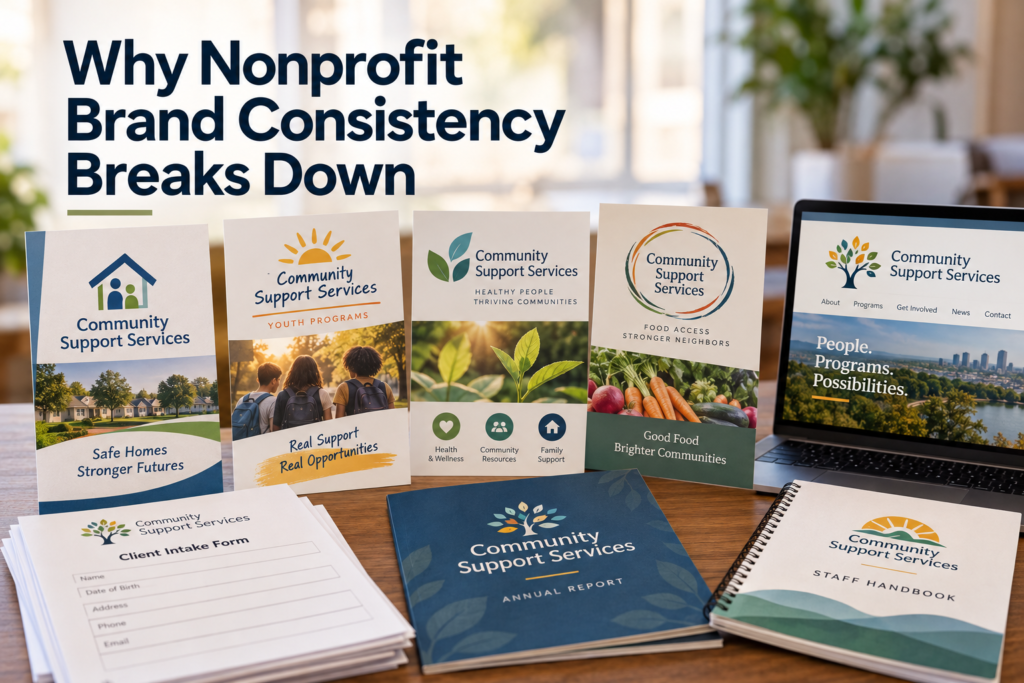
Years ago, when I led marketing for a nonprofit, I learned how quickly a brand could take on a life of its own.
Our organization had multiple programs serving very different people. Each program had its own staff, priorities and history. People were trying to do good work. They were also trying to get things done.
That sometimes meant creating a flyer for an upcoming event without calling marketing. Someone might pull language from an old brochure because it was handy. A staff member needed more intake forms so they made a copy of a copy of a copy of an old form with an old logo and outdated information fields. A program could develop its own way of explaining its work because that language made sense to the people it served.
None of these decisions seemed particularly significant on their own. Over time, though, they created confusion, misunderstandings and even distrust.
The organization looked and sounded different depending on which program—or even which staff member—you encountered.
I’ve written before about some of the common branding mistakes nonprofits make. Many of them start with small decisions like these.
I see the same challenge in many nonprofits today. When nonprofit brand consistency becomes a problem, the first instinct may be to create brand guidelines or add more rules and approval processes. But guidelines can only do so much.
People Make Brand Decisions Every Day
Most brand decisions never reach the marketing department. A program director writes a description for a community partner. A fundraiser explains the organization in a grant application. An executive prepares remarks for an event. Someone at a regional office needs a flyer by Friday so they create their own.
Each person makes choices based on what they know about the organization. Their knowledge is shaped by their role and experience. That’s why strong brand consistency is built long before someone chooses a logo or opens a Canva template.
Your people need to know what the organization stands for and what makes its approach distinctive. They need to understand who you serve and partner with. They also need useful language for explaining the work.
If that understanding varies across your organization, the brand will start to vary, too.
Different Teams Know Different Things
Different teams experience the organization from different perspectives.
Program staff know the people receiving services. They hear their concerns and see the barriers they face. They understand how programs work in ways that people outside those programs may not.
Fundraisers spend time with donors. They learn which stories resonate and which parts of the mission need more explanation. They see what sparks donors’ interest and what leaves them with questions.
Leaders see strategy and long-term priorities. Their perspective may focus more on systems, funding and the organization’s future.
Marketing sees how the organization communicates across audiences. The team can spot inconsistencies in messaging and learn from community partners in ways that other departments may not.
Each team holds knowledge that could help the others better understand the organization. But in a siloed organization, those insights may never travel very far. No single team has the complete picture. When people fill those gaps with what they know from their own experience, different versions of the organization can begin to emerge.
I’ve seen another version of this problem when organizational knowledge depends too heavily on individual employees. I recently wrote about my experiences at LSS when important information wasn’t captured and shared.
That experience is one reason I keep coming back to the question of how knowledge moves across an organization.
Give People More Than a Brand Guide
Brand guidelines are useful. I’ve created them for organizations and relied on them myself. But I’ve also seen beautiful brand guides sit untouched in shared drives.
Sometimes employees don’t know where to find them. Other times, the document answers visual questions but gives people little help with everyday communication.
Think about the person who needs to describe a new program tomorrow. They probably aren’t wondering about the approved font.
They’re wondering: How do I explain this?
Useful brand resources should help answer that question.
Employees need language and examples they can adapt. They also need to understand the thinking behind them. Knowing why the organization describes itself a certain way helps people make better choices when a sample paragraph doesn’t fit the situation.
A sample gives someone words to use today. Understanding the organization gives them a foundation for communicating tomorrow.
Make Brand Knowledge Easy to Find
Access matters too. I’ve worked in organizations where important information lived everywhere. Some of it was on shared drives. Some was buried in old documents. Other information lived in people’s heads.
That creates a practical problem. When someone needs information quickly, they use what they can find or they make something up.
An old program description can easily become the copy for a new flyer. An outdated presentation can become the starting point for a grant application.
Now you have two versions of your story in circulation.
A central place for current brand and messaging resources can prevent some of this. Keep it simple enough that people can find what they need and will actually use it.
Listen to the People Using the Brand
Information also needs to travel back and forth. Program staff hear questions that communications staff may never hear. A regional team may discover that a message makes sense at headquarters but confuses people in its community.
That information is valuable. When I worked in nonprofit marketing, some of the best insight came from talking with the people closest to the work. They could tell me where my understanding was incomplete. Those conversations made our communications stronger.
Brand consistency doesn’t require every program to communicate in exactly the same way. But it does require a common foundation.
Look Beyond the Brand Problem
When I see persistent brand inconsistency, I want to know what’s happening underneath it.
Do employees understand how their program connects to the larger organization?
Do they know which messages matter most?
Can they find current information?
Do teams share what they’re learning with each other?
Those questions tell me much more than whether someone followed the brand guide.
They also point to something I’ve been thinking and writing about a lot lately: shared organizational understanding.
I use that term to describe the important knowledge people across an organization need to do their work and make good decisions.
Shared organizational understanding can include your organization’s mission, values, brand, communications, programs, and the knowledge people gain through their work.
Important organizational knowledge can live in many places. Brand documents hold some of it. Employees carry some. Programs and departments develop more through their daily work. Policy documents and SOPs hold organizational knowledge.
The challenge is making sure that the most important information moves across the organization so people can make good decisions.
Brand consistency is one very visible example of what happens when it doesn’t.
When people share an understanding of the organization, they have a stronger foundation for deciding what to say and how to represent it.
And they don’t have to call the marketing department every time they need to make a decision.
I’m also exploring how shared understanding shows up in everyday organizational life in my Content Marketing Musings newsletter, including how mission, values, and organizational knowledge shape the decisions people make.
How consistent is your organization’s understanding of your brand?
If different programs or locations seem to be telling different versions of your story, take a look at what people understand before adding another page to the brand guide.
I help nonprofits and mission-driven organizations improve nonprofit brand consistency by developing brand strategies and messaging frameworks that give people a shared foundation for communicating and making decisions.
If your organization is struggling with inconsistent messaging or a brand that people interpret differently, let’s talk about what may be causing it.
