
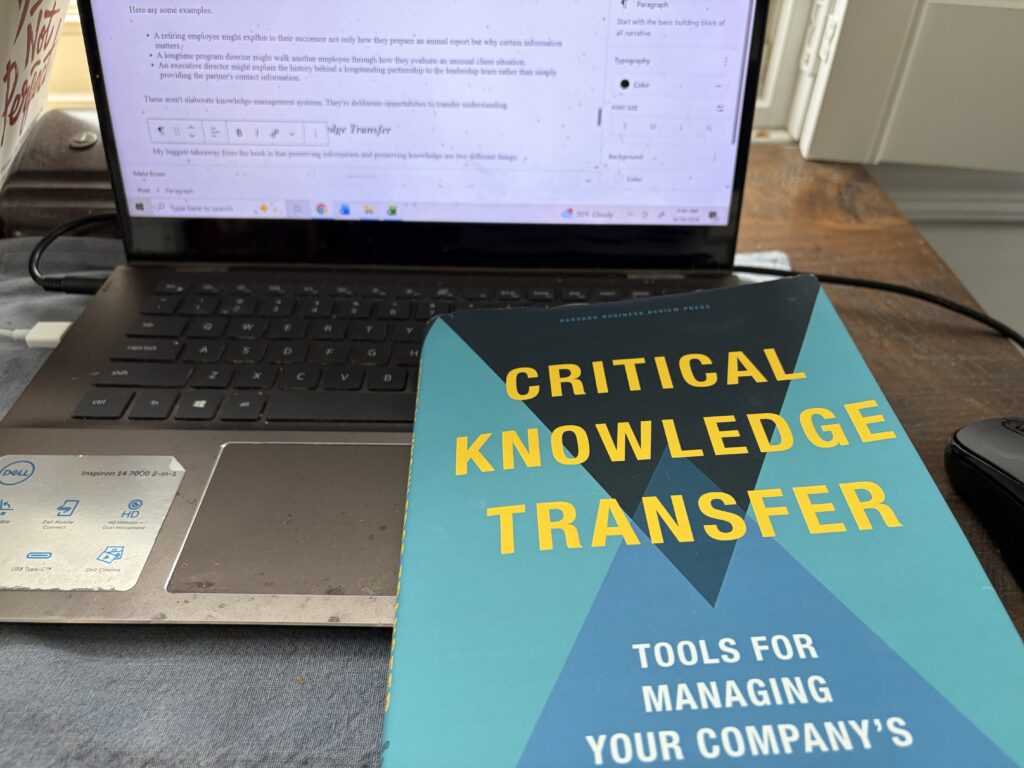
What happens when the person who knows how everything works leaves your organization?
That question is at the heart of Critical Knowledge Transfer: Tools for Managing Your Company’s Deep Smarts by Dorothy Leonard, Walter Swap, and Gavin Barton.
The book explores how organizations can identify important knowledge held by experienced employees and transfer it to other people before that knowledge disappears. The authors call this experience-based knowledge “deep smarts.”
I picked up the book because I’ve been thinking and writing about how organizational knowledge builds shared understanding and organizational capacity.
It gave me a much deeper look at the mechanics of knowledge transfer. But I’ll admit: it’s not an easy read.
Knowledge transfer can get complicated fast. The authors explore different types of knowledge, how people develop expertise, and methods to transfer what experienced employees know to others.
The examples add to that complexity. Case studies come from massive organizations such as Bank of America, Cisco, and even the U.S. Army. They have far more people and resources to devote to knowledge transfer than most of the organizations I work with.
So as I read, I kept thinking about the leader of a small nonprofit or service organization. They may recognize the problem. They know longtime employees hold valuable knowledge that isn’t documented anywhere. But they probably don’t have a knowledge management team or the resources for an extensive knowledge-transfer program.
I started reading the book through a different lens:
How could these ideas be made simpler and more useful for organizations with fewer resources?
The answer, I think, is to focus less on replicating the systems described in the book and more on understanding the principles behind them.
What Is Critical Knowledge Transfer About?
The premise is fairly simple: Some of an organization’s most valuable knowledge exists in people’s heads.
An experienced employee doesn’t just know how a process works. They may know why it works that way. They remember why a decision was made years ago. They recognize which problems require immediate attention and which usually resolve themselves.
Much of that knowledge is difficult to capture in a procedure manual.
When experienced employees retire, leave, or change roles, you can lose more than someone’s labor. You can lose years of accumulated knowledge.
Critical Knowledge Transfer provides a structured approach for identifying that knowledge and intentionally transferring it to others.
What Are “Deep Smarts”?
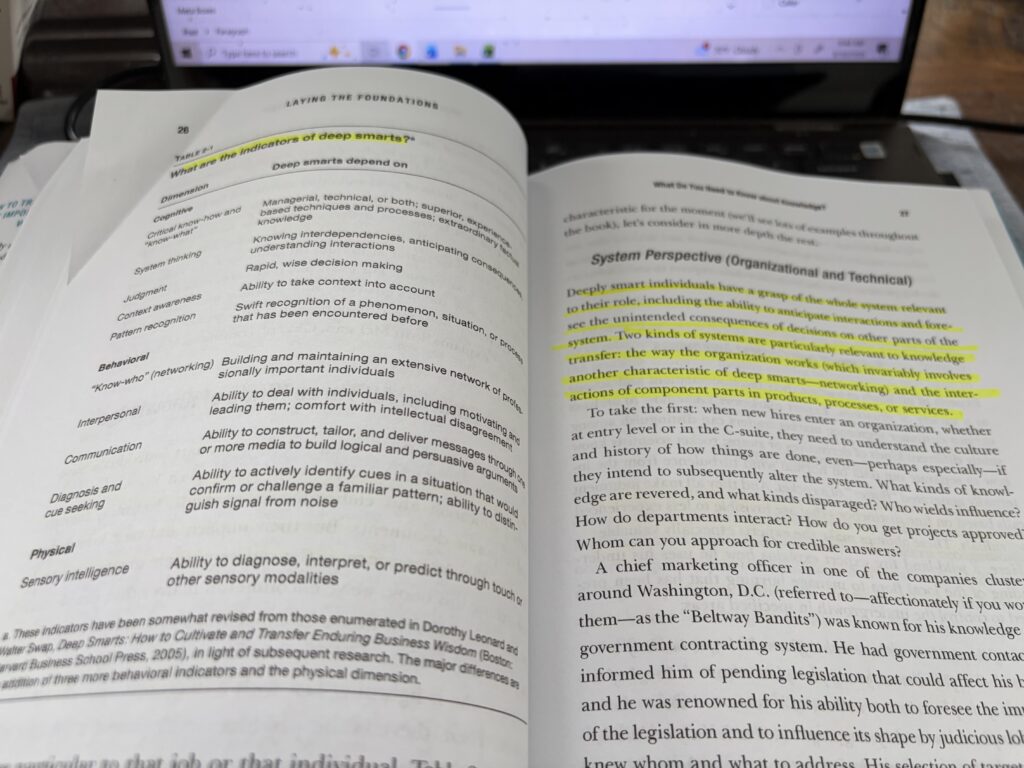
One of the most useful concepts in the book is “deep smarts.”
Deep smarts go beyond facts and information. They’re developed through experience.
Someone with deep smarts doesn’t simply know your organization’s policies. They understand how those policies work in real situations. They recognize patterns. Some know when an exception makes sense. Others understand relationships and history that may never have been formally documented.
This level of detail matters because you may assume that documenting information solves the knowledge problem.
It doesn’t always.
You can put every policy and procedure in a shared drive and still lose important organizational knowledge when a key employee leaves.
A Real Life Example of Deep Smarts
I saw this firsthand when I worked at Lutheran Social Services. Years earlier, the organization had operated an adoption program. By the time I was there, the program was long gone and there was little documentation about it. But people still occasionally contacted us looking for information about their adoption or trying to find family members.
Fortunately, we had a longtime employee who knew about the program. When those calls came in, we relied on her knowledge to help us understand what the organization had done and what information might still be available.
She had become our institutional memory for a program that no longer existed.
What would have happened if she’d left?
That’s the kind of organizational risk Critical Knowledge Transfer asks leaders to recognize. Important knowledge doesn’t always live in a database, procedure manual, or shared drive. Sometimes it lives with one person who has been around long enough to remember.
Knowledge Transfer Is More Than Documentation
The authors don’t treat knowledge transfer as simply writing things down. They look at how organizations can identify critical knowledge, determine who holds it, and decide who else needs to learn it.
They also recognize that different kinds of knowledge need to be transferred differently.
You can document a procedure. It’s much harder to document the judgment someone developed after doing a job for 20 years.
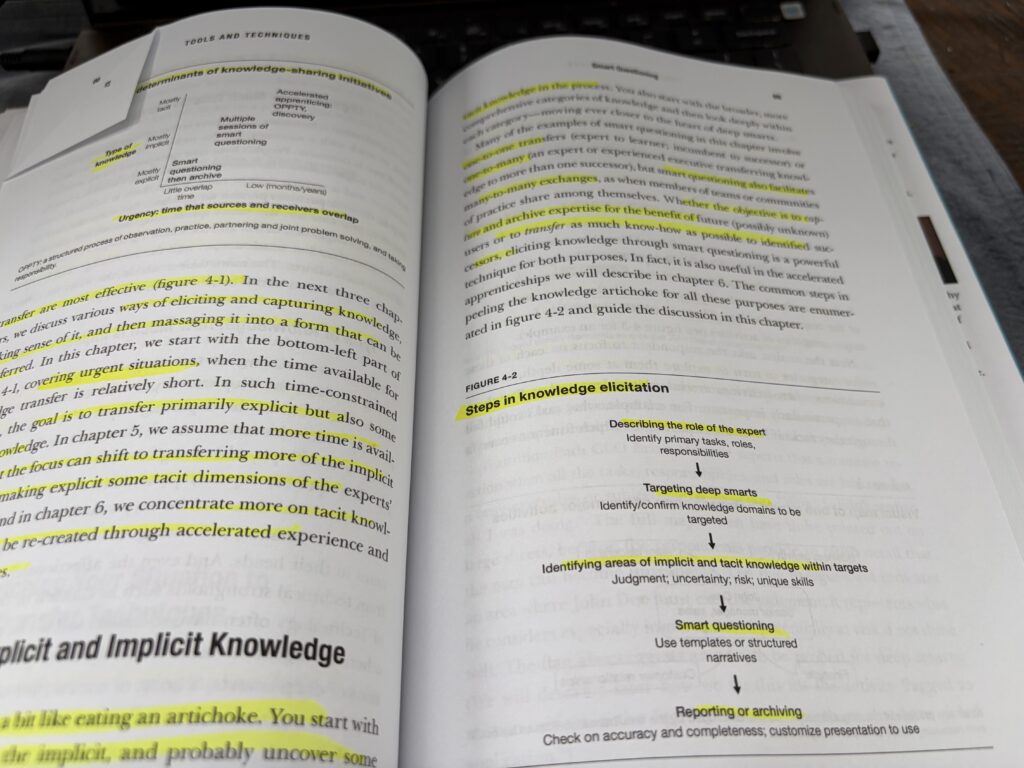
That’s where techniques such as mentoring, observation, questioning, guided experience and working through problems together become important.
How Smaller Organizations Can Apply the Ideas
For a smaller organization, I’d start by simplifying the process. Start with a direct question:
What would we have trouble understanding or doing if this person left tomorrow?
The answer can tell you where your knowledge risk is.
Then identify who else needs that knowledge and find practical ways for them to learn it.
Sometimes documentation will be enough. Other times, someone needs to see the knowledge being used.
Here are some examples:
- A retiring employee might explain to their successor not only how they prepare an annual report but why certain information matters.
- A longtime program director might walk another employee through how they evaluate an unusual client situation.
- An executive director might explain the history behind a longstanding partnership to the leadership team rather than simply providing the partner’s contact information.
These aren’t elaborate knowledge-management systems. They’re deliberate opportunities to transfer understanding.
One Idea I Would Steal: An OPPTY Plan for Onboarding
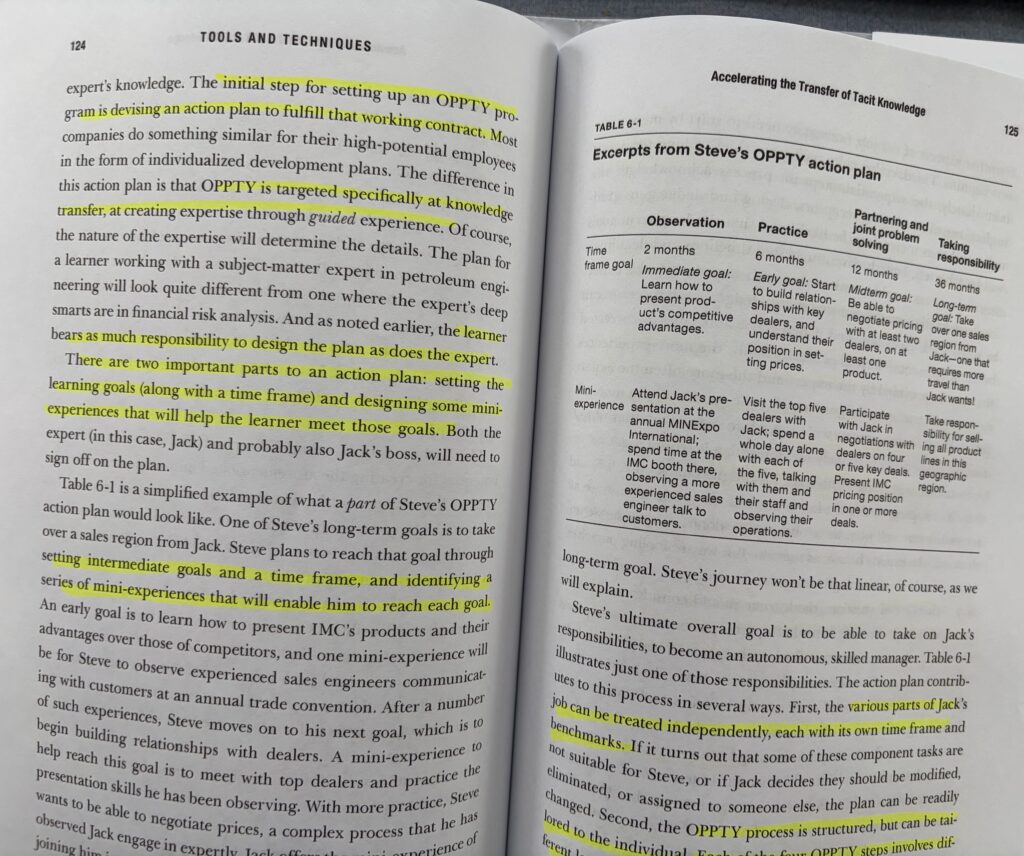
One of the ideas I found most useful was something the authors call an OPPTY plan. OPPTY is their approach to creating guided experiences that help someone develop knowledge through doing, rather than simply being told how something works.
The book’s examples can be extensive. But I kept thinking about how the basic idea could be incorporated into onboarding.
Most onboarding plans focus heavily on information. Read the employee handbook. Review policies. Meet the team. Learn the systems. Complete required training.
What if we also asked:
What does this person need to experience to really understand how this organization works?
A simple OPPTY plan could become part of every new employee’s onboarding plan. Along with what they need to read, learn and complete, identify what they need to experience.
They might observe an experienced colleague handling a difficult situation, work alongside someone on an important project, practice making a decision with feedback, and eventually take responsibility for something themselves.
Just as important, they talk about what happened afterward. After an experience, the book suggests questions that help the learner think about what happened: What did I do? Did it work? What feedback did I get? What did I learn?
That’s an approach even a small organization could use. Instead of creating another elaborate onboarding process, ask:
What should this person observe, practice, do with someone else, and eventually be able to do independently?
Looking back at my adoption-program example, an OPPTY plan could have helped us think differently about that longtime employee’s knowledge. Instead of continuing to rely on her whenever a call came in, someone else could have observed how she handled those calls, worked through cases with her, asked why she made certain decisions, and gradually learned enough to handle them independently.
Over time, knowledge held by one person could have become knowledge shared by others.
My Takeaway From Critical Knowledge Transfer
My biggest takeaway from the book is that preserving information and preserving knowledge are two different things.
According to the authors, knowledge is “information that is relevant, actionable, and at least partially based on experience.”
That definition shows how powerful knowledge can be.
Organizations need documents, processes and accessible information. But those resources don’t necessarily capture the experience, context, and judgment people use to make decisions.
For smaller organizations, that risk can be especially significant. When you have 10 or 15 employees, losing one longtime employee can mean losing a substantial amount of what your organization knows.
Critical Knowledge Transfer offers a sophisticated framework for addressing that risk. You probably won’t need every tool in the book.
But you do need to ask the question behind them:
What does our organization need to know, and who else needs to know it?
Is Critical Knowledge Transfer Worth Reading?
I’d recommend Critical Knowledge Transfer to organizational leaders, consultants, and anyone responsible for succession planning, organizational capacity, or knowledge management.
If you lead a smaller nonprofit or service organization, don’t read it expecting to implement the system exactly as written. Read it for ideas.
Find the concepts that address your organization’s biggest knowledge risks. Simplify them. Adapt them to the resources you have.
And don’t wait until someone gives notice to figure out how much of your organization is stored in their head.
How Much Knowledge Lives in Someone’s Head?
You don’t need a knowledge management team or a complicated system to start protecting your organization’s institutional knowledge.
If you’re not sure where important knowledge lives or how to make it easier for others to understand and use, I can help.
Schedule a discovery call to talk about building shared organizational understanding before important knowledge walks out the door.
