

I’ve been thinking a lot lately about organizational decision-making and how leaders make decisions when the path forward isn’t obvious.
No matter what sector you’re in or the type of organization you lead, these are uncertain times. It feels like every decision carries more risk than it used to. Resources are limited. Expectations are high. New opportunities compete with existing priorities, and every choice means saying no to something else.
Should we launch a new program or strengthen an existing one? Do we pursue this funding opportunity? Is now the right time to hire? How do we communicate difficult decisions to our stakeholders?
I’ve noticed that leaders often respond in one of two ways. Some become hesitant, worried that one wrong decision could have lasting consequences. Others move quickly, believing that any action is better than indecision.
Neither approach is a strategy. One is driven by fear. The other by urgency.
What gives leaders the confidence to make difficult decisions when there isn’t a clear right answer?
The more I’ve thought about it, the less convinced I’ve become that confidence comes from experience, a committed board, a high-performing team, or even a strong balance sheet. I’ve met first-time founders who make remarkably thoughtful decisions and seasoned executives who struggle to move forward. I’ve seen organizations with limited budgets navigate uncertainty exceptionally well, while others with far greater resources find themselves revisiting the same conversations.
Different Perspectives, Different Priorities
Every stakeholder views the organization through a different lens, shaped by their responsibilities, experiences, and priorities.
The executive director may be thinking about long-term sustainability, but the development director is focused on donor expectations.
Program leaders are advocating for the people they serve. Board members are considering governance and financial stewardship.
None of these perspectives are wrong. They’re simply incomplete on their own.
The answer, I think, has less to do with individual leadership and more to do with what an organization knows collectively.
A Different Way to Think About Decision-Making
Organizations revisit the same conversations not because they lack intelligent people or good intentions. They revisit them because they haven’t developed a shared understanding of the organization itself.
The missing ingredient isn’t another planning session or another strategic document.
It’s shared organizational understanding.
Shared organizational understanding is more than making sure everyone has access to the same information. It’s the collective knowledge and perspective that helps an organization move in the same direction.
Shared organizational understanding isn’t about everyone thinking the same way. It’s about ensuring everyone begins from the same foundation.
Shared Organizational Understanding Becomes the Lens
Why? Shared understanding becomes a common point of reference. It gives everyone the same lens for evaluating opportunities, solving problems, and making difficult decisions.
Shared organizational understanding doesn’t eliminate disagreement. Healthy organizations don’t eliminate different perspectives. They create a shared framework that allows those perspectives to strengthen decision-making instead of fragmenting it.
What changes is the starting point. Instead of defending individual opinions, everyone begins from the same understanding of the organization’s purpose and principles.
Instead of asking,
- “What do you think?”
- “Which option do you prefer?”
- “What’s worked before?”
Teams begin asking,
- “What best reflects our mission?”
- “What serves our audience?”
- “What aligns with our values?”
- Which choice moves us toward our vision?
Those are very different conversations.
Shared Understanding Doesn’t Happen by Accident
Organizations don’t develop shared understanding simply because talented people work together. It has to be built intentionally, reinforced consistently, and carried forward as the organization evolve.
This raises an important question.
If shared organizational understanding is so important, how do organizations build it? More importantly, how do they preserve it as staff members change, board members rotate off, and new challenges emerge?
Organizations need a way to capture what they’ve learned and know so it doesn’t live only in the minds of individual leaders or founders.
One of the most effective ways is through a well-defined brand framework.
Brand Is One Way Organizations Capture Shared Understanding
Many people think of brand as a logo, a website, or an advertising campaign. Those are important expressions of a brand, but they aren’t the brand itself.
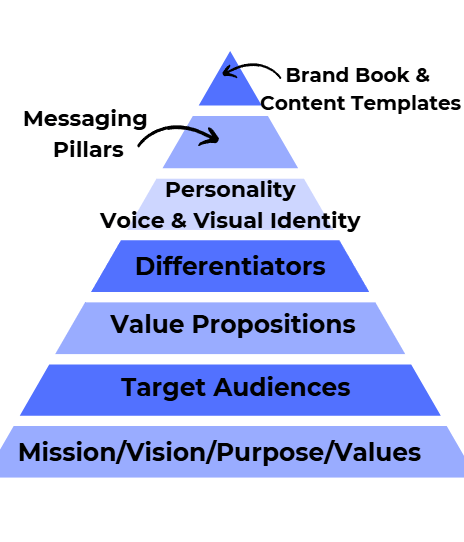
A brand framework captures an organization’s shared understanding and turns it into practical guidance for organizational decision-making, helping leaders, staff, and board members make more consistent decisions every day.
A strong brand framework answers the questions every organization should be asking:
- Why do we exist? (Mission)
- Where are we headed? (Vision)
- What do we value? (Values)
- Who do we serve? (Audience)
- What makes us different? (Positioning)
- How should we show up? (Personality)
- How do we communicate consistently? (Messaging)
This isn’t a marketing exercise. It’s an organizational one. A brand framework helps organizations capture what they know about themselves so that knowledge can guide decisions, communications, and leadership long into the future.
Shared Understanding Builds Organizational Capacity
Over time, shared organizational understanding strengthens organizational decision-making and becomes organizational capacity. It helps new employees onboard more quickly, leadership teams navigate uncertainty with greater confidence, boards make decisions more consistently, and communications reinforce the same mission and priorities. The organization becomes less dependent on individual personalities because the knowledge needed to move forward is shared.
This article is the first in a series exploring the practical frameworks organizations can use to build shared organizational understanding. Together, these frameworks help leaders make better decisions, strengthen communications, and build lasting organizational capacity.
To begin, I’ve created a free Organizational Decision Audit to help you evaluate whether your organization has the shared understanding needed to make confident, consistent decisions.
Ready to Build Stronger Decision-Making?
If your organization is revisiting the same conversations, struggling to align stakeholders, or making important decisions without a shared framework, I’d love to help.
Through facilitated workshops and practical frameworks, I help mission-driven organizations build shared organizational understanding so leaders, staff, and boards can make better decisions, communicate more consistently, and strengthen organizational capacity.
