

In my recent articles, I’ve been exploring what happens when nonprofits sound alike.
When you’re strapped for time and working without a real communications budget, it’s tempting to borrow language from larger organizations in your sector. To reuse digital assets. To echo phrases that seem to be working elsewhere.
But when you try to sound like everyone, you end up appealing to no one.
Because when messaging is interchangeable, supporters get confused. And confused supporters hesitate. Hesitation slows support. It slows momentum
Today, I want to move that conversation into the C-suite.
Because if your CEO sounds like everyone else, you’re sending a confusing and concerning message to some of your most important stakeholders.
A message that says:
We do what everyone else does.
We sound like everyone else sounds.
We haven’t defined what makes us different.
And that can have significant consequences.
Your CEO Is Your Most Visible Brand Signal
Brand is your public identity and reputation.
It’s the emotional connection you build and the promises you make.
Marketing is how you express it. Fundraising is how you activate it.
But when the CEO speaks — in a donor letter, at an annual meeting, in legislative testimony, during a major gift conversation — that’s brand building.
In those moments, your CEO must be compelling enough to hold attention, relatable enough to build trust, and convincing enough to inspire action. The stakes are higher. The audience is listening differently. They aren’t just evaluating programs. They’re evaluating confidence, clarity, and direction.
If your brand foundation is unclear, your executive messaging will be unclear. If your positioning is generic, your CEO will sound generic. If your differentiators haven’t been named, they won’t show up in your most important conversations.
And when that happens, even strong leadership will sound less persuasive than it should..
The Problem With Generic Nonprofit CEO Brand Messaging
Let’s take a familiar example.
A typical major donor thank you letter might say:
“Because of generous supporters like you, we are making a meaningful difference in the lives of those we serve…”
There is nothing wrong with that sentence.
But it could belong to almost any nonprofit in any sector.
Now imagine that same organization has clearly defined:
- Its differentiators
- Its positioning
- Its messaging pillars
- Its personality and voice
The CEO letter might instead say:
Here in Franklin County, family homelessness rarely begins at a shelter door. It begins when rent rises faster than wages and one unexpected expense destabilizes a fragile household budget. We focus upstream, intervening before temporary setbacks become long-term housing loss. Because of your investment last year, 312 families moved from crisis to stability, securing permanent housing, employment support, and case management designed to prevent repeat homelessness.”
Now we’re hearing something specific.
We see:
- A clear problem definition.
- A distinct approach.
- A measurable and timebound outcome.
- A recognizable point of view.
Now, make the message relevant to the donor. Using what you know about the donor and their interests, tell a short story about one of the 312 families to showcase impact. If the donor cares deeply about employment support, tell the story of how your program helped Mike get a good paying welding job. If the donor is worried about children in the homeless system, tell a story about how your program got a family of 6 out of the shelter in record time. Make sure to directly tie these outcomes back to the donor’s investment.
Now, your organization is set apart from all of the others. That’s brand clarity at work.
Major Donors Invest in Leadership Clarity
Major donors are not just funding programs.
They are investing in leadership confidence.
When a CEO speaks with:
- Clear positioning
- A defined approach
- Consistent language
- Stories that reinforce core messaging pillars
Donors feel certainty.
They understand:
- What makes you different.
- Why your approach works.
- Where you’re headed.
- How they can help.
- How their investment advances long term strategy and goals.
Clarity reduces hesitation and reduced hesitation accelerates action.
What Brand-Informed Testimony Sounds Like
This is true for all CEO messaging, not just fundraising. Consider legislative or committee testimony.
Many nonprofit leaders default to:
- Statistics
- Urgent language
- Budget requests
- Broad moral appeals
All are important, but not distinct or memorable. Decision-makers hear statistics and funding requests all day long. What they don’t hear is a clearly articulated point of view.
Brand positioning shapes how you frame the issue.
If your organization is positioned as a bold reformer, your CEO may challenge systems directly and call out inefficiencies.
“We don’t have a funding problem alone. We have a coordination problem. Right now, three agencies collect the same data and none of them share it. Families have to apply for aid over and over again. They’re navigating a maze the government designed. We can fix that.”
If your brand is rooted in trusted collaboration, testimony may emphasize cross-sector solutions and partnerships.
“No single agency can solve this alone. What’s working in our county is coordinated case management across housing, workforce development, and public health. When we share data and align goals, families stabilize faster.”
If you are known as a research-driven expert, your framing will center on evidence and long-term outcomes.
“Our five-year data shows that families who receive prevention-focused rental assistance are 42% less likely to return to shelter within 24 months. The evidence is clear: early intervention reduces long-term system costs.”
The facts may overlap with other organizations.
The framing will not.
That framing is where distinctiveness lives.
Annual Meetings and Keynotes: Where Brand Personality Shows Up
This is where brand personality becomes unmistakable.
Every nonprofit has a personality, whether it’s defined or not.
Are you…
The Courageous Challenger
“We’ve been asking families to navigate a system that was never designed for them to succeed. This year, we stopped accepting that as normal. We pushed for policy change, we challenged outdated practices, and we refused to confuse activity with impact.”
Tone: Bold. Direct. Slightly uncomfortable by design.
The Steady, Evidence-Based Guide
“Over the past three years, we’ve studied what actually keeps families stably housed. The data shows that when employment support and rental assistance are delivered together, long-term outcomes improve significantly. So we refined our model and it’s working.”
Tone: Calm. Credible. Reassuring.
The Compassionate Community Builder
“This work is about neighbors helping neighbors. It’s about making sure no parent has to choose between rent and groceries. This year, because of this community, hundreds of families experienced stability they didn’t think was possible.”
Tone: Relational. Warm. Inclusive.
The Innovative Systems Thinker
“Family homelessness isn’t a housing problem alone. It’s also a systems design problem. So this year, we mapped the entire journey families take through our county’s support network and redesigned it to reduce friction and duplication.”
Tone: Strategic. Big-picture. Future-focused.
Same stage.
Same annual meeting.
Same issue.
Very different leadership voice.
And that’s the point.
Brand personality doesn’t only shape your campaigns. It shapes how leadership sounds when the spotlight is on.
When your understand your brand personality, CEO speeches:
- Feel cohesive.
- Reinforce the same core themes
- Reflect consistent tone.
- Return to a recognizable worldview.
Without that clarity, executive messaging tends to drift. Speeches cover too many ideas. Program updates replace positioning. The message feels forgettable.
And when a speech could be delivered by any other nonprofit leader, your brand equity erodes.
The Hidden Risk: Internal Confusion
There’s also an internal cost to unclear messaging from the C-suite.
When CEO messaging lacks brand alignment:
- Staff hear mixed signals.
- Boards struggle to articulate differentiators.
- Fundraising teams rewrite language repeatedly.
- Marketing creates new messaging for every campaign.
Momentum stalls because every initiative starts from scratch.
Brand clarity prevents that.
It provides a throughline that carries from:
- Donor letters
- Board decks
- Keynote addresses
- Fundraising events
- Legislative testimony
- Staff town halls
- Even everyday emails
Consistency builds confidence.
Confidence builds alignment.
Alignment builds momentum.
A Simple Executive Messaging Audit
If you’re a nonprofit CEO or if you support one, here’s a practical exercise.
Pull three recent executive communications:
- A donor letter
- A public speech or presentation
- A written statement or testimony
Then ask:
- Could this belong to another organization?
- Are our differentiators visible?
- Do our messaging pillars show up?
- Does our positioning come through?
- Is our personality recognizable?
If the answer is “not really,” the issue isn’t the talents of your team or the intent of your message.
It’s a lack of brand clarity. You cannot communicate what you haven’t clearly defined.
Your Brand Should Make You Unmistakable
Your organization has a brand. The question is whether it’s intentional and whether it’s shaping leadership voice.
Strong nonprofit leaders understand that brand isn’t a logo or a tagline. It’s a strategic imperative. It guides decisions. It clarifies direction. It shapes perception.
A strong brand is built on a foundation of mission, vision, purpose, and values.
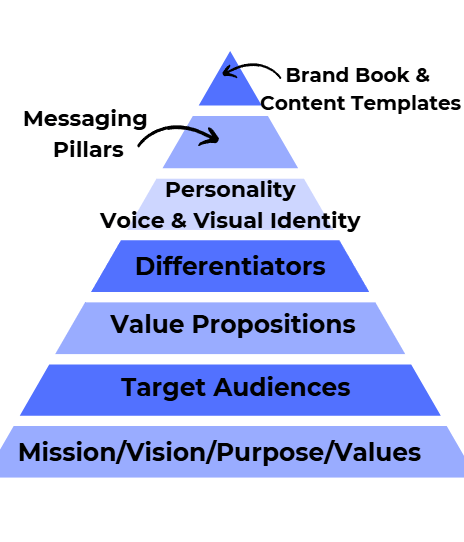
When your brand informs executive messaging, perception shifts.
Donors feel conviction.
Policymakers feel credibility.
Staff feel alignment.
Boards feel direction.
You become unmistakable.
And that’s where momentum builds.
Speak With Confidence and Clarity
Because the difference between confusion and action often comes down to confidence.
When a CEO speaks with clarity about who the organization is, what it stands for, and how it’s uniquely positioned to solve a problem, people lean in. Donors ask better questions. Board members feel steadier in their governance role. Policymakers listen differently. Conversations shift from surface-level updates to strategic partnership.
Your mission deserves more than sounding like everyone else in the sector.
It deserves language that reflects its distinct role in the community and leadership that communicates that role with conviction.
That’s what builds real momentum from the inside out.
Brand Clarity Doesn’t Happen by Accident
If you’re a nonprofit leader who worries that your organization sounds competent but not distinct or if you want your executive messaging to reflect the full strength of your strategy, I’d be glad to help.
Let’s make your nonprofit CEO brand messaging unmistakable.
