
Lately, I’ve been struggling to make an important decision about my business. It’s not for lack of information or ideas. It’s that frustrating kind of stuck where you can see both paths clearly and can’t seem to take a step in either direction.
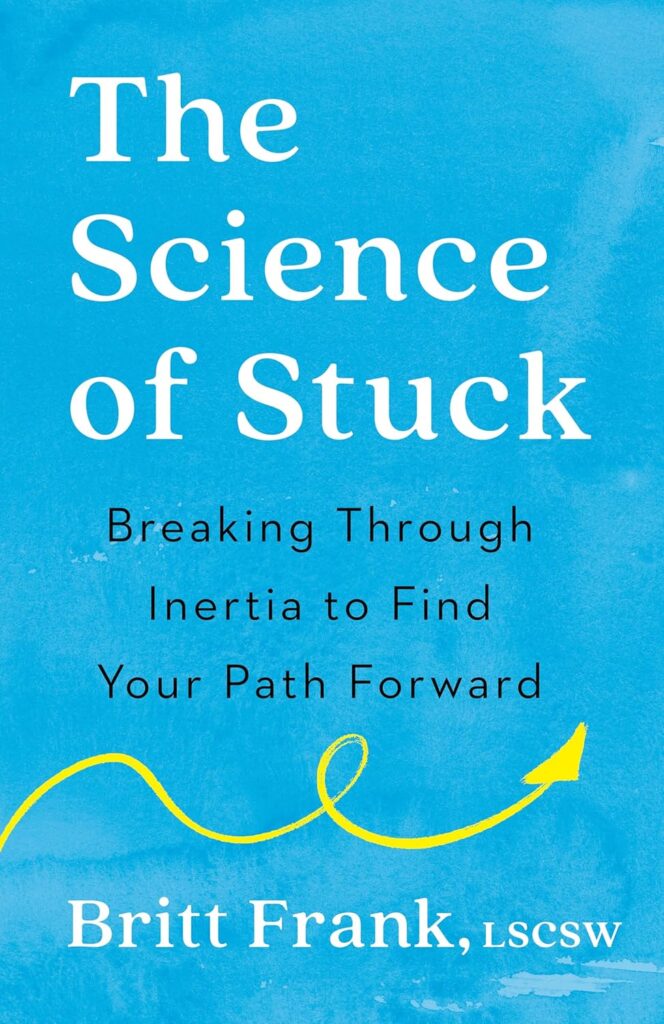
That’s what led me to The Science of Stuck by Britt Frank. Here’s my book review.
I was hoping for a roadmap to decisive action, but instead, I found something more fundamental: a better understanding of how our minds respond when we feel overwhelmed or uncertain.
When Procrastination Isn’t the Problem
Frank’s book focuses on why we procrastinate, not out of laziness or lack of discipline, but because of how our brains process (or can’t process) stress and trauma. It wasn’t exactly the practical decision-making guide I was looking for, but it was a powerful reminder that my past experiences shape how I move through the present.
Reframing Anxiety as a Superpower
One idea that really stayed with me was her perspective on anxiety. Frank reframes it not as a flaw to be fixed, but as a signal from the brain that something needs attention. Thinking of anxiety as a form of intuition—a superpower, even—feels freeing. It changes the question from “How do I get rid of this?” to “What is this trying to tell me?”
Feelings, Emotions, and the Stories We Tell Ourselves
I also appreciated how she differentiates between anxiety, fear, and worry, and between feelings, emotions, and thoughts. Taking a pause to identify which one I’m experiencing before reacting is a small but powerful mindset shift. Her definition of emotion as feelings plus stories also hit home for me. So many of my emotions are shaped by past experiences, especially the ones that left me feeling alone, unsafe, or unprotected.
It’s easy to forget that I’m not that vulnerable girl any longer, that I have agency and power to shape both my present and future.
Understanding Trauma
Frank also offers a clear, compassionate definition of trauma as an internal state where the brain can’t fully process information. Our responses (fight, flight, or freeze) aren’t failures; they’re our brains doing their best to protect us based on perception, not necessarily reality.
So many times in the past, I’ve been frozen in what feels like fear, and I couldn’t figure out why. I didn’t want to admit that I’d experienced trauma in my life. But that’s exactly what it was, my brain’s response to what it thought was another trauma-inducing event.
That framework helps me see my current hesitation over this decision in a new light. Maybe I’m not indecisive. Maybe I’m just noticing old protective instincts trying to keep me safe.
Maybe It’s Not Indecision. Maybe It’s Protection
The book includes thoughtful prompts for reflecting on what’s happening in your mind and body when you feel stuck. I’m still working through them (and still undecided), but I’m more aware now of the effects of fear and anxiety as I deliberate.
Progress Looks Different for Everyone
For me, sometimes progress doesn’t look like a decision. It looks like understanding myself well enough to make one when I’m ready. So that’s my book review for The Science of Stuck.
If you’re struggling with a big decision or tackling an overwhelming project, this book is for you. Give it a read and let me know what you think!
Let’s talk! Schedule a call with me today.
