
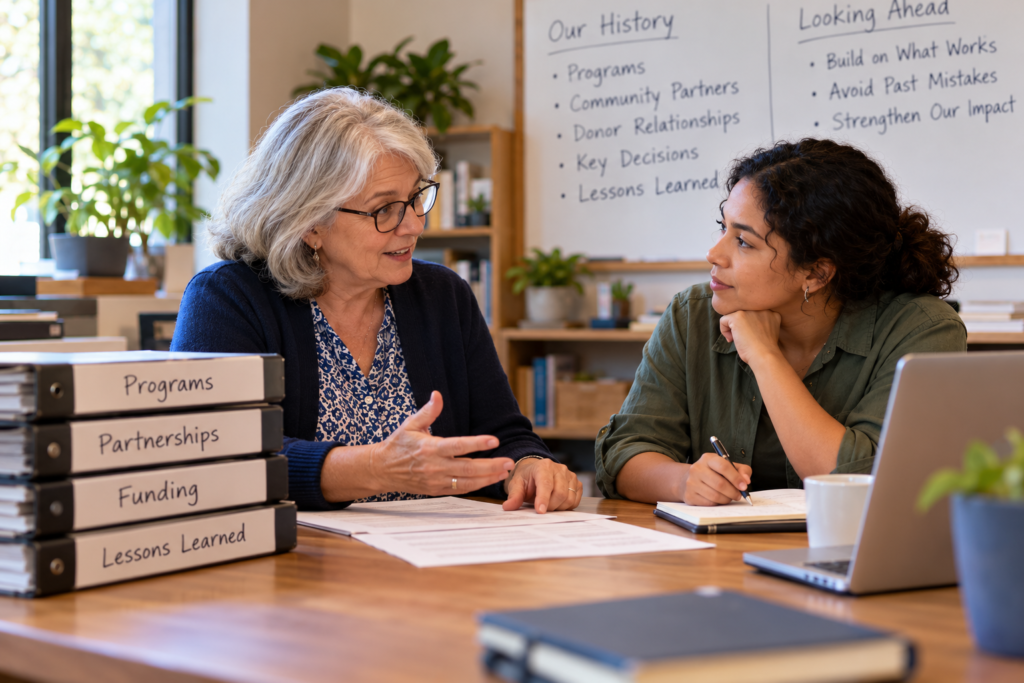
Your Nonprofit’s Most Valuable Knowledge May Be Walking Out the Door
What would your nonprofit lose if your longest-serving employee retired tomorrow?
You might lose years of program history, relationships with community partners, and an understanding of why certain decisions were made. You might also lose something harder to replace: the judgment that comes from years of experience.
I was reminded of this while reading a recent Nonprofit Quarterly article by James A. Lomastro, “Wisdom Workers: The Capacity Nonprofits Must Learn to Recognize and Preserve.”
Lomastro shares a story about a retired telephone-company troubleshooter who volunteered at the nonprofit hospital where he worked. He asked her to review a complicated audit report involving suspected misuse of restricted funds.
Within 48 hours, she identified where the misuse had occurred, how long it had been happening, and what needed to be done.
Her contribution came from years of experience recognizing patterns and spotting problems that others might overlook. At the very least, she saved Lomastro hours of tedious and complicated work.
Lomastro calls people like her “wisdom workers.” They bring experience and judgment that help organizations solve problems, anticipate challenges, and make better decisions.
His article makes a compelling case for recognizing and preserving their wisdom. It also raises a question I’ve been thinking about in my work with nonprofits.
How do we make sure that valuable nonprofit institutional knowledge becomes part of the organization, rather than remaining with one person?
When Organizational Knowledge Lives in Someone’s Head
During my years at Lutheran Social Services of Central Ohio, I worked with a longtime employee who had an extraordinary understanding of the organization’s history.
Every once in a while, we’d get a phone call from a community member who was looking for information about an adoption program we’d operated years earlier. There was very little documentation available. We depended on this employee’s memory to piece together the program’s history and figure out where we might find the information the caller needed.
She knew things that weren’t written down anywhere. Without her, we would have had almost nowhere to start.
I suspect most nonprofit leaders can think of someone like her in their organization.
Maybe it’s the program director who remembers why a particular service was discontinued. Or the development professional who understands the history of a donor relationship. Perhaps it’s the administrative employee who understands why a process works the way it does.
These employees carry knowledge that helps the organization function. Yet much of what they know remains undocumented or difficult for others to access.
That’s a vulnerability, particularly for nonprofits with small teams and limited resources.
When experienced employees leave, valuable knowledge can leave with them
Preserving Nonprofit Institutional Knowledge Requires More Than Documentation
A logical response is to start documenting what people know. Create procedure manuals. Record interviews with longtime employees. Organize shared files. Build a knowledge base.
These are useful steps. I’ve encouraged nonprofits to do many of them. But having information available doesn’t necessarily mean people understand it or know how to use it.
If you’re leading a nonprofit that discontinued a program several years ago, a document might tell you when the program ended and who made the decision. That’s useful information.
But, knowing why the decision was made is even more useful. Perhaps funding disappeared, community needs changed, or the organization discovered that another approach produced better results.
Imagine that knowledge is available to your people making decisions today. They understand the circumstances behind the earlier decision and can use those lessons when considering a new program.
That’s shared organizational understanding: people across your organization have access to important knowledge, understand what it means, and can use it to guide their work.
An organization can have thousands of documents and still struggle with the same problems because people don’t know what information exists, where to find it, or how to apply it.
The goal is to make organizational knowledge useful.
Some Wisdom Can Only Be Learned Through Experience
Lomastro offers another example of a wisdom worker: an experienced nursing home manager who can review a staffing schedule and recognize which residents might receive inadequate care before a problem occurs.
A spreadsheet might show that a shift meets staffing requirements. But an experienced manager may recognize risks that the numbers don’t reveal. She understands the residents, the staff, and the circumstances that can affect care.
That kind of judgment develops over years of experience.
You can document processes, policies, and decisions. But deep organizational knowledge develops through experience and learning from mistakes.
In my recent review of Critical Knowledge Transfer: Tools for Managing Your Company’s Deep Smarts, I explored several approaches organizations can use to preserve this kind of knowledge.
One of the most useful ideas is guided experience. Instead of simply asking an experienced employee to explain how they do something, have them work alongside someone who needs to learn it.
Let the newer employee observe how decisions are made, ask questions, and gradually take responsibility with guidance and feedback.
For example, a longtime program director might involve a newer colleague in a challenging planning conversation. An experienced development professional could walk a colleague through the history of a donor relationship and explain how that history influences their approach.
These experiences help people understand the thinking behind the work.
The important part is making the learning intentional.
Recognizing Wisdom Is an Organizational Choice
One of the most interesting examples in Lomastro’s article is Dignity Alliance Massachusetts, a coalition focused on nursing home oversight and advocacy.
The coalition draws on the experience of retired administrators, clinicians, and former government officials. These individuals understand the systems they’re working to improve because they’ve spent their careers inside them. Their combined experience helps the coalition analyze complicated financial arrangements, understand legislation, and advocate for meaningful policy changes. The organization deliberately brings together different kinds of expertise and creates opportunities for those individuals to use their knowledge.
There’s an important lesson here for nonprofit leaders.
Experienced employees need opportunities to share what they know. That means making time for mentoring, inviting their perspectives into planning conversations, and listening when they question an approach or raise concerns.
It also means recognizing that knowledge sharing should work in both directions. Longtime employees have valuable experience, while newer colleagues may bring different perspectives and ideas. Your organization benefits when those perspectives come together.
I’d take Lomastro’s argument one step further. We also need to think about what happens to that knowledge after it’s shared.
If an experienced employee helps solve a problem, does anyone document what was learned? Do colleagues understand the reasoning behind the solution? Can others apply that knowledge the next time a similar situation arises?
Without those steps, your organization may benefit from someone’s wisdom today without building the capacity to use it tomorrow.
Building Knowledge Transfer Into Everyday Operations
Most nonprofits don’t have the resources to launch an extensive knowledge management initiative. Fortunately, there are practical ways to begin.
Start by identifying where critical knowledge lives. Ask your team which decisions, relationships, processes, or programs depend heavily on one person’s experience. Where would your organization struggle if someone were suddenly unavailable? Those are good places to start.
Capture the reasoning behind decisions. Meeting minutes often record what was decided but leave out why. Include the circumstances, alternatives considered, and lessons learned. A few sentences of context today could save someone hours of research in the future.
Include organizational knowledge in onboarding. New employees need policies and procedures, but they also benefit from understanding the organization’s history. Consider pairing new employees with experienced colleagues who can explain how programs evolved and why certain practices exist.
Create opportunities to learn from experienced colleagues. Invite employees to participate in planning conversations, observe experienced colleagues, and take on new responsibilities with feedback. This helps them develop the judgment that comes from experience.
Make knowledge easy to find and use. Even a simple, well-organized shared folder can help if people know where to look. Make sure someone is responsible for keeping important information current.
And perhaps most importantly, encourage people to ask questions and share what they’ve learned.
These practices don’t have to become a major initiative. They can be built into meetings, onboarding, project reviews, and everyday conversations.
From Individual Wisdom to Organizational Capacity
Nonprofits depend on the dedication and experience of their people. That experience is an extraordinary asset, especially in organizations where resources are stretched and the work is complex.
But relying too heavily on individual knowledge creates risks. Programs can lose momentum during staff transitions. New employees may repeat mistakes that others have already learned from. Leaders may make decisions without understanding the history behind current practices.
When important knowledge is shared across the organization, people are better equipped to make informed decisions and adapt as circumstances change.
This is one reason I’ve become increasingly interested in shared organizational understanding as a capacity-building strategy.
We often think about nonprofit capacity in terms of funding, staffing, technology, and systems. I agree that all are important. But your organization’s ability to understand and use what you already know deserves attention, too.
Lomastro’s article reminds us how much wisdom experienced employees contribute. The next challenge is finding ways to preserve that wisdom and make it useful to others.
That takes some intentional effort, but it can begin with small changes in how your organization communicates, documents decisions, and helps people learn from one another.
One Question Worth Asking
Think about the people in your organization who seem to know everything. The ones everyone turns to when they need an answer, some historical context, or advice about a difficult situation.
What do they know that others don’t? And what are you doing to make sure that knowledge continues to benefit your organization?
Start with one important process, one experienced employee, or one piece of organizational history.
The first step toward preserving organizational wisdom is recognizing where it lives. The next is making sure others can benefit from it.
Want to Strengthen Your Organization’s Shared Understanding?
I help nonprofits identify gaps in nonprofit institutional knowledge and develop practical ways to make important information easier to find, understand, and use.
Let’s talk about how to build that capacity in your organization.
